


Timer-alerts for the hard-of-hearing
The problems
There are all sorts of situations where one wants to keep track of time and be alerted when the time is up. The obvious example is in cookery, but there are numerous others, all of which call for a timer-alert of some sort. However, with hearing loss, it is no easy matter to find a alert that is suitable:
- The alerts on watches tend to be too quiet.
- Vibration alerts on phones are fiddly to set up and often not strong enough to feel with heavy clothing.
- Regular kitchen times are generally packaged in such a way that it is impossible to remove them to try them out before buying - and the description on the packaging is seldom sufficiently detailed or reliable for judging usefulness. In my experience, with my particular hearing loss, most are effectively useless.


- Trying out timers is an expensive business because the packaging is such that it cannot be removed and resealed undamaged - and timers which turn out to be unsuitable are not taken back for resale because they are no longer in their original pristine packaging.
Features required in a timer alert for someone with hearing loss
The first question to ask is whether one wants the alert to be a sound, a visual flashing, a vibration or something else.
Flashing alerts
In my experience, visual flashing on any domestic timer alert is of little use because the flashing is not bright enough to notice unless one happens to be in the dark or is keeping one's eyes constantly on the alert. Neither of these situations fit in with a normal life.
Vibrating alerts
Vibrating alerts could be ideal if the vibration were strong enough to notice and/or could be set up in contact with the skin. To be noticeable, vibrations need to be energetic and of a low frequency. I have never found one that is really effective.
Sound alerts
So until a manufacturer comes up with something else, I am left with sound alerts - see my recommendations below. First though an aside on seeking help from the experts.
Experience of buying a timer alert from a national organisation ostensibly to support hearing loss
It seemed sensible to check the online shop of a national UK organisation to support hearing loss. I will not give its name for fear of repercussions, but my experience was far from satisfactory. I had felt that the organisation would surely only sell products that worked well for hearing-impaired people.
When I checked the website of this national organisation, there were a range of watches and clocks with alerts, but only one alert of the sort suitable for a kitchen timer. It looked just what any hearing-impaired person would need - small, flashing, vibrating and loud. I asked for it as a Christmas present and eagerly tore off the packing. This was a major mistake because the national organisation consequently refused to take the timer back although how I could test it without damaging the packaging remains a mystery. See my review.
I did send the organisation a review of the timer for its website, but it was never published. Existing reviews which were all extremely short and totally positive remained up. Interestingly reviews of the product on the websites of major online retailers, not aimed at the hearing-impaired, did reflect my concerns.
I suggested to the national organisation that they ask me to test their products, free of charge, before adding them to their sales portfolio. My suggestion was "forwarded to the department concerned" but not taken up.
Review of a timer on sale from a national organisation to support hearing loss
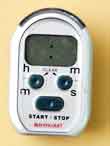
The specifications of this timer looked excellent: it could be set to sound, to flash and to vibrate, apparently ideal for anyone with hearing loss. It can be worn on a belt or can stand on a surface.
-
I could not hear the sound alert unless it was held close to my ears, which is impractical for normal use. (The problem was the relatively high pitch.) To be fair, others with normal hearing could hear it satisfactorily but it did say that it was loud and it was from a national organisation for the deaf.
-
None of my family could notice the flashing alert unless we were in the dark or watching closely - again impractical for normal use.
-
None of us could notice the vibration unless we were concentrating on it, even when the timer was placed on the skin - again impractical for normal use.
-
The belt clip could work satisfactory for its stated purpose but was unsuitable for holding a cord as a pendant because the balance was such that the timer tipped up.
Review of a mechanical timer on sale in shops and on the internet
My experience of mechanical timer alerts is much more positive.
-
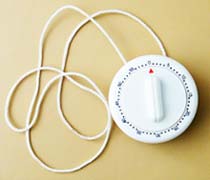
A ring is loud enough and low enough for me, with my hearing problems, to hear even when it is the other side of the room.
-
The ring is reasonably extended.
-
The clip at the back can hold a cord so that the timer can be worn as a pendant.
-
The timer is light enough to be worn as a pendant.
-
The timer is cheap - only a few pounds, although the cost does vary from one online shop to another.
-
A disadvantage of this particular time is that its range is only an hour, so it may have to be set more than once for a single event. There is probably a later version available now.
-
Manual timers of this sort cannot be relied on for accuracies greater than 1 -2 minutes. Electronic timers would be more accurate.
Because the majority of people can hear better at low frequencies, this review is likely to be typical for other mechanical timers. Most are available fairly cheaply on the internet.
Experience of buying a timer alert from an old-style shop
I was fortunate to find an old-fashioned shop that was selling its timers loose, so that I could try them out - a rare luxury that is unlikely to be repeated. The best one for me was an old-style mechanical one which rang loudly at a low pitch. It is available packaged in various shops and on the internet, which is why I am showing a picture of it with my review on the left. Incidentally it was also cheap.
Recommendations
- Within reason, a low pitch is more important for a hearing-impaired person than a loud volume. So if you can't try out the timer, go for the old-style mechanical sort where a pointer is moved round a dial to wind it up. The sound tends to be much lower pitch and louder than with the electronic battery versions.
- Go for a timer with an extended ring rather than a single ping or bleep.
- See also the page on smart phones which can have timer alerts which are particularly good useful and are accurate to the second.
More on timer alerts for people with hearing loss
Choosing a timer alert that can be heard
Carrying a timer alert to hear it ring

Disclaimer: The information on this site is for a lay audience and I cannot be responsible for errors or omissions. The views, strategies, advice and suggestions etc are based on my personal experience and are not necessarily appropriate for anyone else. They should, hopefully, stimulate individuals to develop their own strategies.