


Hearing loops in talks and lectures: best practice
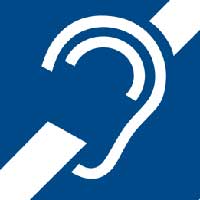
Symbol displayed in a room or building showing that it has a hearing loop system. Variations may include the letter T because hearing aids need what is called the T setting.
Would you believe it! For all the years that I have had hearing aids and for all the places that display the symbol for having a hearing aid loop system, I have only visited two where the loop system worked effectively! This is such a pity because almost all hearing aid users can benefit from the loop facility. Just a simple flick of a switch on the hearing aids turns on what is known as the T-setting.
So what has gone wrong? And does it matter anyway? Do loop systems really help significantly? And what can be done to improve matters? This review tries to answer these questions and more. It is based on my own experience.
The technical bit -
What is a loop system and how does it work?
A loop system is a wire-free connection between listeners' hearing aids set to the loop or T setting and a sound device such as tv, radio or microphone. The sound signal goes through a loop of wire which is set up round the room, and this loop induces a signal which carries the sound directly and wirelessly to all hearing aids inside the loop. Room acoustics and background noise etc play no part. So, the sound seems right there beside everyone inside the loop if their hearing aids are on the T setting. All NHS hearing aids have this setting, although an audiologist may need to turn it on.
When can a loop system help with hearing loss?
Can loop systems help people with hearing aids to hear better? Absolutely yes! The noise and clatter of people and the room acoustics just fade away - provided of course that the system is set up properly and the speakers are using it correctly, but more on this shortly.
A loop system really comes into its own when individuals wearing hearing aids are sufficiently far way away from a source of electronic sound that they cannot hear clearly with their hearing aids set for normal use - like in a group or lecture situation where the speaker is using a microphone. A properly working loop system makes the speech sound as if the person speaking is sitting right next to them.
When can't a loop system be expected to be of much help?
The hearing loop ear symbol can generally be seen at checkouts in large stores. Even if it is working properly, though, the hearing aid wearer is normally so close to the speaker that the standard setting on the hearing aid sounds little different from the loop setting.
Common reasons why loop systems don't help people with hearing aids


- The most common reason why loop systems do not work is that they are not turned on - even though the ear symbol is prominently displayed. Some time ago, on a group visit, I made a point of asking if there was a loop system and was met with some surprise at the question. The reply was "Yes, we have one. Would you like it turned on?". Of course I said that I would, but more importantly I learnt a lot from that remark. I had assumed that loop systems, where they existed, were always turned on - but no. Hearing loss is invisible and it is not generally appreciated by people with normal hearing how widespread it is. Also of course without a hearing aid there is no obvious way of telling that the system is switched on, other than perhaps an alert light somewhere.
- The next most common reason seems to be that speakers are not trained how to use loop systems. Quite apart from the system being turned on, a loop system requires a microphone for the person speaking. This can be hand held, hung round the neck, on a headset or in a fixed position in front of the person speaking. The latter is preferable, as speakers tend to rub their hands on hand-held microphones, or their clothes rub on microphones round their necks. The rubbing produces disturbing, unpleasant sounds.
One of the few places where I have experienced a good working loop system had the microphone unobtrusively placed on the speaker's desk, not even his lexturn. I would have thought that this would have been the least helpful positioning, but it worked perfectly. It was in a museum which was empty at the time, and the staff member was happy to help me to experiment. I asked him to speak normally as if to a visitor standing at the desk while I went to the end of the hall. Standing that far away, I could still hear him perfectly. No-one without a hearing aid set to the T setting would even know that any amplification was taking place.
It is of course essential for anyone using the loop to be inside it. This is no problem where the loop is embedded in or around the walls, as it is in most professional settings, but it may not be. The answer is to ask where to sit for use of any loop system so not to be outside the loop.
Here is an example of failure in a dentists' surgery. They had bought a portable loop system for their reception area and they clearly displayed the T sign. However, the system didn't work, even when I had got the staff to turn it on. Why? They hadn't appreciated that users needed to be inside the loop. When this had been explained to them, they were concerned that customers would trip over the coiled wire. So the loop system remains unused, although the T sign still remains clearly displayed.
- Loop systems need to be able to be turned on independently of normal loudspeaker systems. The worst loop system that I have experienced was a council one. Presumably the council had been cutting costs. The loop system could not operate independently. So when it was turned on, so was the main loudspeaker. Then the audience vocally complained that the speech was too loud and distorted. So the loudspeaker system was turned off, and so accordingly was the loop system. Nevertheless, in spite of this major failure, the council could gain its brownie points by proudly stating that the room had a loop system and by accordingly displaying the ear symbol.
I experienced an excellent example of the two systems working independently. It was in a lecture theatre. When I spoke to the speaker afterwards and expressed pleasure at the crystal clarity of the loop system, he showed surprise. He said that he didn't even know that he was using a microphone or that any sound system had been turned on. The microphone was attached to the lectern with the loop system turned on, but it was thankfully independent of the loud-speaker system which was not turned on.
You must be beginning to see why the loop setting on your hearing aid doesn't seem to be working!
So what can be done to improve matters?
- There is something simple and immediate that we can all do to improve matters wherever we see the ear symbol or feel there ought to be one. It is to ask whether the loop is turned on; check whether this includes a microphone for the person speaking also turned on; and ask where to sit so as to be inside the loop. The person being asked probably has no idea of the answers. We have to be persistent and eventually get hold of the right person who does or should know the answers.
- In the medium term something that we can do to improve matters is to keep suggesting to those in charge of events that they indicate on their publicity that a working loop system will be available. This may make them realise if it isn't and do something about it.
- My last suggestion is worth doing but is unlikely to meet with success in the short or medium term and without extensive lobbying. It is to get owners of public rooms to invest in a loop system that does not distort, is embedded around the walls or floor, and, very importantly, is independent of any loud-speaker system.
Hearing loops in the home
For some considerable time, I didn't have a hearing loop in my home for listening to television, radio or electronic music. My reason was that I like to watch with my family who wanted to hear normally, and, anyway, I was reasonably happy with subtitles.
However, I did know people who had loop systems in their homes. One woman told me about a time when she and her husband, who both had hearing aids, were using their loop system to watch a film on television. The room itself, of course, was completely quiet because the normal television loudspeaker was turned off. Someone walked into the room and said, "What are you both doing watching television with no sound!"
Now, as another member of my family also has hearing aids, there is a loop system in our house. The loop is simply wound closely round the base of our chairs, so that it can be removed easily if necessary. It was home-made by a family member who could do such things, but it has so proved its worth that I would recommend buying if that is the only option.
I have since been in several homes with room loop systems used for television. The loop is unobtrusive and safe from tripping over because it runs under the carpet.
Portable hearing loop systems
As already implied, a loop system can be portable. This means that the wire that is the loop has to be draped round where people are going to be, rather than being secured permanently and safely round the edge of the room. Take care because the loose wire loop can all too easily be tripped over.
My excellent experience of portable loop systems for individual use is on a separate page.
The working range of hearing loop systems
There is another issue with hearing loop systems. It is the range over which they can operate. A system for the home obviously does not need to reach as far as one for a public place. Range affects price. Sales outlets normally specify both and should be able to advise. Information is also available on the internet.
Costs of loop systems
If I were to quote costs here, they would soon be out of date. Let me just say that when I first looked at them, I was amazed at how cheap they were. Obviously the better the quality and the wider the range, the greater the cost. So have a look at what is available on the internet. I think you will be pleasantly surprised.

Disclaimer: The information on this site is for a lay audience and I cannot be responsible for errors or omissions. The views, strategies, advice and suggestions etc are based on my personal experience and are not necessarily appropriate for anyone else. They should, hopefully, stimulate individuals to develop their own strategies.